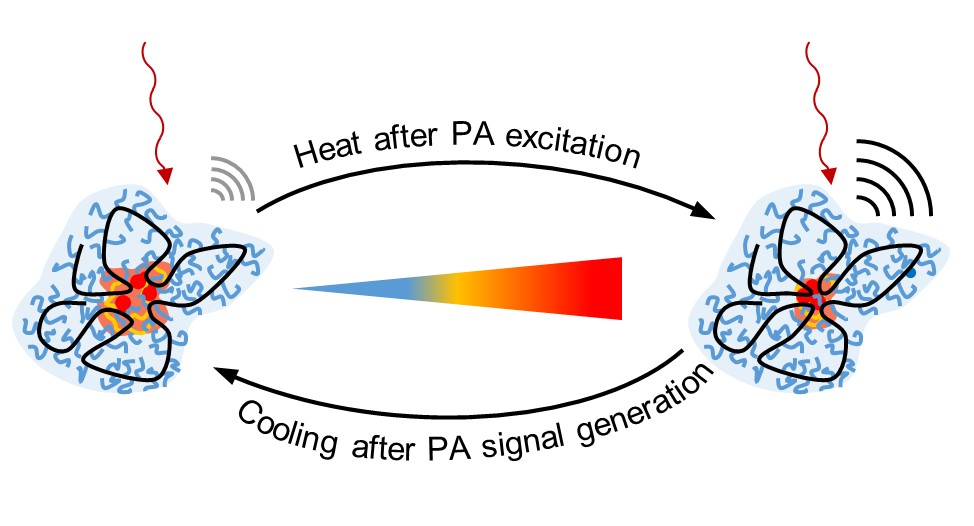
Thermoresponsive Swelling of Photoacoustic Single-Chain Nanoparticles

Thümmler, J.F. et al., Chemical Communications, 2023, DOI https://doi.org/10.1039/D3CC03851C

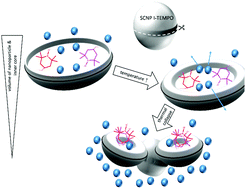
NIR-fluorescent LCST-type single-chain nanoparticles (SCNPs) change their photophysical behaviour upon heating, caused by depletion of water from the swollen SCNP interiors. This thermoresponsive effect leads to a fluctuating photoacoustic (PA) signal which can be used as a contrast mechanism for PA imaging. Published with a permission of the Royal Society of Chemistry 2023.
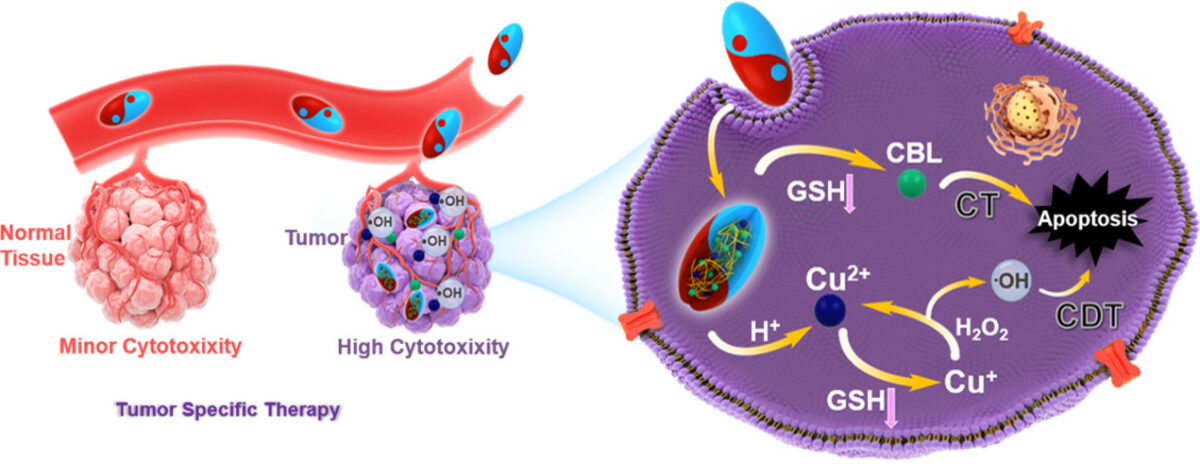
Core-Coordinated Elliptic Polymer Nanoparticles Loading Copper(II) and Chlorambucil for Cooperative Chemodynamic/Chemotherapy

Qiu, X. et al., Biomacromolecules, 2022, 4519–4531,

https://pubs.acs.org/doi/10.1021/acs.biomac.2c00656

Chemodynamic therapy (CDT) reflects an innovative cancer treatment modality. To enhance its relatively low therapeutic efficiency, rational combination with extra therapeutic modes is highly appreciated. Here, core-coordinated amphiphilic, elliptic polymer nanoparticles (Cu/CBL–POEGEA NPs) are constructed via the self-assembly of a glutathione (GSH)-responsive polymer–drug conjugate. Side-chain acylthiourea (ATU) motifs are affixed, which behave as ligands capable of coordinating Cu(II). Benefitting from the GSH-induced reduction reaction, Cu(II) is converted into Cu(I) and subsequently react with endogenous H2O2 to create OH, realizing GSH-depletion-promoted CDT. Additionally, the disulfide bond endows GSH-responsive CBL release and provokes further GSH decline, finally realizing combined CDT/CT toward enhancing antitumor outcomes, and in vitro as well as in vivo studies indeed reveal remarkable efficacy. Copyright © 2022, American Chemical Society

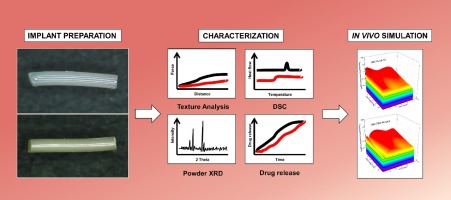
Towards the optimization of drug delivery to the cochlear apex: Influence of polymer and drug selection in biodegradable intracochlear implants

Lechner E. et al., International Journal of Pharmaceutics, 2023, 123268,

https://doi.org/10.1016/j.ijpharm.2023.123268

There is growing need for new drug delivery sytems for intracochlear application of drugs to effectively treat inner ear disorders. In this study, we describe the development and characterization of biodegradable, triamcinolone-loaded implants based on poly(lactic-co-glycolic acid) (PLGA) and polyethylene glycol–poly(lactic-co-glycolic acid) (PEG-PLGA) respectively, prepared by hot-melt extrusion. PEG 1500 was used as a plasticizer to improve flexibility and accelerate drug release. PEG-PLGA implants showed an initial slow release rate over several days regardless of the amount of PEG added. Mathematical simulations of the pharmacokinetics of the inner ear based on the in vitro release kinetics indicate a complete distribution of triamcinolone in the whole human scala tympani, which underlines the high potential of the developed formulation. © 2023 The Authors. Published by Elsevier B.V.

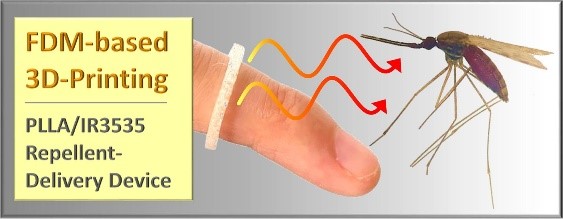
3D-printing of the polymer/insect-repellent system poly (l-lactic acid)/ethyl butylacetylaminopropionate (PLLA/IR3535)

Du, F., et al. Int. J. Pharmaceutics, 2022, DOI:https://doi.org/10.1016/j.ijpharm.2022.122023   

The polymer/solvent system poly (l-lactic acid)/ethyl butylacetylaminopropionate (PLLA/IR3535) is regarded as an insect-repellent-delivery system, serving, e.g., for fighting mosquito-borne tropical diseases. In this work, samples of the polymer/repellent system PLLA/IR3535 were prepared by 3D-printing. The experiments showed that it is possible to print 3D-parts containing up to 25 m% repellent, with an only minor loss of repellent during the printing process. The study successfully proved the applicability of the technology of extrusion-based 3D-printing for the preparation of polymer parts with a specific shape/design containing mosquito-repellent at a concentration which raises the expectation to be used as a repellent delivery-device.

3D-printing of Triamcinolone Acetonide in Triblock Copolymers of Styrene-Isobutylene-Styrene as a Slow Release System

Hilgeroth, P., et al. Polymers, 2022, DOI:https://doi.org/10.3390/polym14183742

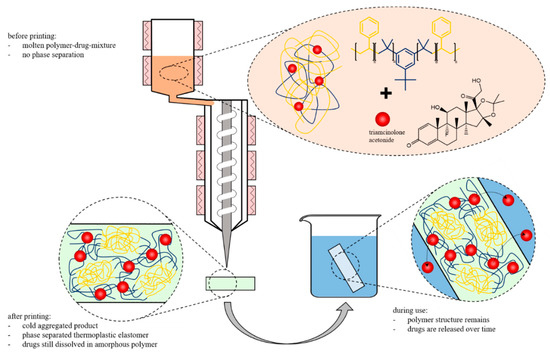
Additive manufacturing has a wide range of applications and has opened up new methods of drug formulation, in turn achieving attention in medicine. We prepare and use styrene–isobutylene–styrene triblock copolymers (SIBS; Mn = 10 kDa–25 kDa, PDI 1,3–1,6) as a drug carrier for triamcinolone acetonide (TA), further processed by fused deposition modeling to create a solid drug release system displaying improved bioavailability and applicability. Continuous drug release and morphological investigations were conducted to probe the influence of the 3D printing process on the drug release, enabling 3D printing as a formulation method for a slow-release system of Triamcinolone.

Tuning the internal compartmentation of single-c­hain nanoparticles as fluorescent contra­st agents

Thümmler, J. F., et al. Macromol. Rapid. Commun., 2022, DOI:https://doi.org/10.1002/marc.202200618

Controlling the internal structures of single-chain nanoparticles (SCNPs) is an important factor for their targeted chemical design and synthesis, especially in view of nanosized compartments presenting different local environments as a main feature to control functionality. We here design SCNPs (sized 6 – 12 nm) bearing near-infrared fluorescent dyes embedded in hydrophobic compartments for use as contrast agents in pump–probe photoacoustic (PA) imaging. SCNPs with the dye molecules accumulate at the core and show a nonlinear PA response as a function of pulse energy—a property that can be exploited as a contrast mechanism in molecular PA tomography.

Hydrogen-bonded supramolecular polymer-micelles with pH/photothermal-responsive carmofur release and combined chemo-photothermal therapy

Wu, Y., et al. Polym. Chem., 2022, DOI:https://pubs.rsc.org/en/content/articlelanding/2022/py/d1py01634b

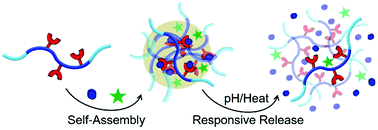
Integrating biomedical applications (e.g., drug delivery) into supramolecular chemistry is a promising strategy. This work targets the construction of hydrogen-bonded (H-bonded) supramolecular polymeric micelles loaded with chemotherapy drugs (carmofur) and photothermal agents (IR780) for combined chemo-photothermal therapies (CT/PTT).

3D printing of solvent-free supramolecular polymers

Rupp, H., et al. Frontiers in Chemistry, 2021, DOI:https://doi.org/10.3389/fchem.2021.771974

Additive manufacturing has significantly changed polymer science and technology by engineering complex material shapes and compositions. With the advent of dynamic properties in polymeric materials as a fundamental principle to achieve, e.g., self-healing properties, the use of supramolecular chemistry as a tool for molecular ordering has become important. We here review recent progress in the 3D printing of supramolecular polymers, with a focus on fused deposition modelling (FDM) to overcome some of its limitations still being present up to date and open perspectives for their application.

Nanoscale structure and dynamics of thermoresponsive single-chain nanoparticles investigated by EPR spectroscopy

Roos, A. H., et al. Soft Matter, 2021, DOI:https://doi.org/10.1039/D1SM00582K

We characterize temperature-dependent macroscopic and nanoscopic phase transitions and nanoscopic pre-transitions of water-soluble single chain nanoparticles (SCNPs). We analyze the temperature-dependent phase transitions of spin-labeled SCNPs by rigorous spectral simulations of a series of multicomponent EPR-spectra that derive from the nanoinhomogeneities (1) that are due to the single-chain compartmentation in SCNPs and (2) the transformation upon temperature change due to the LCST behavior. These transitions of the SCNPs and their respective polymer precursors can be monitored and understood on the nanoscale by following EPR-spectroscopic parameters like hyperfine couplings that depend on the surrounding solvent molecules or Heisenberg spin exchange.

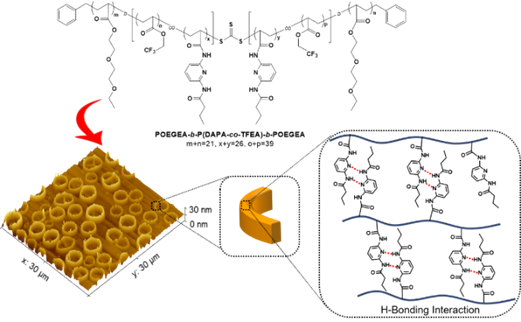
Hydrogen-bonding mediated self-assembly of amphiphilic ABA triblock copolymers into well defined giant vesicles

Wang, H., et. al. J. Polymer Chemistry, 2021, 12, 6300-6306, https://doi.org/10.1039/D1PY01061A

Giant vesicles represent an extremely useful system to mimick biomembranes. By designing a hydrogen-bonding (H-bonding) amphiphilic ABA triblock copolymer and introducing 2,6-diaminopyridine (DAP) moieties as pendant groups within the middle hydrophobic block, we demonstrate a straightforward and effective self-assembly strategy to form giant vesicles (~3 μm in diameter) via a combination of H-bonding and amphiphilic interactions. This study provides a new opportunity for the design of supramolecular polymers, serving as polymeric vesicle scaffolds in material design and may act as red-blood-cell-like container in delivery and microreactor applications. Published with a permission of the Polymer Chemistry 2021.