Photo-Thermoresponsive Polypyrrole-Crosslinked Single-Chain Nanoparticles for Photothermal Therapy

Thümmler, J. et. al., Commun. Chem., 2025, 8, 124, https://doi.org/10.1038/s42004-025-01518-x

Irradiating a chromophore allows cancer diagnostics by photoacoustic (PA) imaging, but also causes transformation of light into thermal energy (PTT). We in this study have designed water-dispersible, nanocaged polypyrroles (PPy), embedded into single-chain nanoparticles (SCNP, sized 6.8 – 8.9 nm) displaying thermoresponsivity, so reaching largely increased PTT-effects, reaching temperatures up to 85°C. In a parallelized 96-well-plate-design the PPy-SCNPs can effect an almost complete death of illuminated (cancer) cells at already low concentrations (0.001 mg/mL) with low radiant fluxes. Copyright © 2025 Springer, The Author(s). Open access.

Supramolecular Micelleplex Co-Delivers Bcl-2 siRNA and Paclitaxel for Synergistic Chemo-Gene Cancer Therapy

Wu, Y. et. al., Small Methods, 2026, e00760, 10, 1,  https://doi.org/10.1002/smtd.202500760

Combined chemotherapy (CT) and gene therapy (GT) represent a reliable modality toward drug-resistant tumor treatment. Herein, a supramolecular polymeric scaffold is reported to co-load chemodrug paclitaxel (PTX) and Bcl-2 small interfering RNA (siRNA), respectively via hydrogen-bonding (H-bonding) association and electrostatic interaction, toward efficiently reversing drug resistance and significantly inhibiting tumor growth in a synergistic manner via GT-enhanced CT. The cationic shell consisting of P(OEGA-co-DMAEA) (poly(oligo(ethylene glycol) monomethyl ether acrylate-co-2-dimethylaminoethyl acrylate)) from resulting PTX-loaded micelles can steadily bind the negative siRNA via electrostatic interaction, finally to afford the targeted supramolecular micelleplexes PTX@PODHT/siRNA. The so generated nanoplatform possesses the enhanced co-loading capacity and transportation stability of PTX and siRNA and can induce pH-responsive cargos release within the tumor zone to effectively inhibiting tumor growth via synergistic CT/GT. © 2025 Wiley-VCH GmbH

Mono- and Bivalent Poly(iso-butylene)-alanines for Drug-Delivery of Nimodipine and Triamcinolone Acetonide

Hilgeroth, P. S. et. al., Macromol. Rapid. Commun., 2025, e00321, 47, 14, https://doi.org/10.1002/marc.202500321

Poly-iso-butylene (PIB) is a well known biocompatible polymer with application as a solid drug delivery system. We here investigate the impact of embedded oligo-alanine-units (Ala) to induce beta-sheets and the release of drugs from a so solidified PIB. Based on mono- (PIB-Ala2-Ac, 12,2 kDa) and bivalent PIB-polymers (PIB-(Ala2-Ac)2, 16,7 kDa) with attached oligo(alanines) as endgroups were synthesized and induce beta-sheets to adjust the mechanical strength of these biomaterials. Two drugs, nimodipine and triamcinolone acetonide, are incorporated into different PIB matrices and display a stable release of the drugs over a period of 42 days into a PBS buffer, thus presenting an attractive material for long-term targeted release with adjustable mechanical properties. © 2025 The Author(s). Macromolecular Rapid Communications published by Wiley‐VCH GmbH. Open access.

“Mix-and-Match”: Self-Sorting Assembly Governed Supramolecular Polymeric Nanomedicine for Boosting Combined Chemo/Phototherapy

Wu, Y. et. al, Adv. Mater. 2025, 2502416,  https://doi.org/10.1002/adma.202502416

We report a hydrogen-bonded (H-bonded) supramolecular nanoformulation generated by self-sorting of chemo-prodrug (FPtF) and phototherapeutics (BPeB) to reach an autonomous nanomedicine with improved anti-tumor efficacy by combining chemo/phototherapy (CT/PT). To directly stimulate phototherapy from BPeB via near-infrared (NIR) light, upconversion nanoparticles (UCNPs, β-NaYF4:Yb,Er) are encapsulated to form polymeric nanomicelles, i.e., F/B/U@PHDO, accompanied with a chemo-prodrug release through pH/thermal-stimuli. © 2025 Wiley-VCH GmbH

Enhancing Drug Release from PEG-PLGA Implants: The Role of Hydrophilic Dexamethasone Phosphate in Modulating Release Kinetics and Degradation Behavior

Lehner, E. et. al, Eur. J. Pharm. Sci., 2025, 107067, ttps://doi.org/10.1016/j.ejps.2025.107067

Poly(lactic-co-glycolic acid) (PLGA) is a prominent biodegradable polymer used in biomedical applications. PLGA’s ability to control drug release is often hindered by nonlinear release profiles and slow initial drug release for hydrophobic drugs. This study investigates the incorporation of dexamethasone phosphate (DEXP) into polyethylene glycol–poly(lactic-co-glycolic acid) (PEG-PLGA) implants to enhance the initial release rate of dexamethasone (DEX).Dexamethason phosphate, DEXP improves initial drug release from PEG-PLGA implants via hot-melt extrusion. DEXP further increases implant swelling, water uptake, and mass loss during degradation, so reaching a faster DEX release but a shortening of the overall release duration. © 2025 The Author(s). Published by Elsevier B.V. Open access.

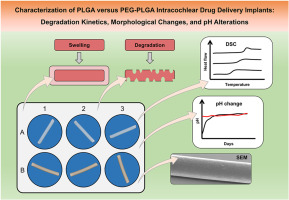
Characterization of PLGA versus PEG-PLGA intracochlear drug delivery implants: Degradation kinetics, morphological changes, and pH alterations

Lehner, E. et. al., Journal of Drug Delivery Science and Technology 2024, Volume 99, 105972, https://doi.org/10.1016/j.jddst.2024.105972

Drug delivery to the inner ear presents a unique challenge due to the complex inner ear anatomy and its tight physiological barriers. This study investigates the degradation behavior of intracochlear drug delivery implants (IDDI) composed of dexamethasone and poly(lactic-co-glycolic acid) (PLGA) or polyethylene glycol–poly(lactic-co-glycolic acid) (PEG-PLGA), respectively. IDDI were incubated in artificial perilymph and implants’ degradation kinetics, morphological changes, water uptake behavior, and pH alterations were assessed. Microscopy revealed significant changes in appearance, with PLGA IDDI exhibiting rapid expansion, reaching up to 183 % in diameter and 185 % in length. PEG-PLGA implants showed gradual expansion, reaching a maximum of 178 % in diameter and 144 % in length. Despite these morphological changes, the IDDIs could still be applicable in terms of cochlear dimensions in combination with cochlear implants (CI) in humans or in a domestic pig animal model. © 2024 The Authors. Published by Elsevier B.V.

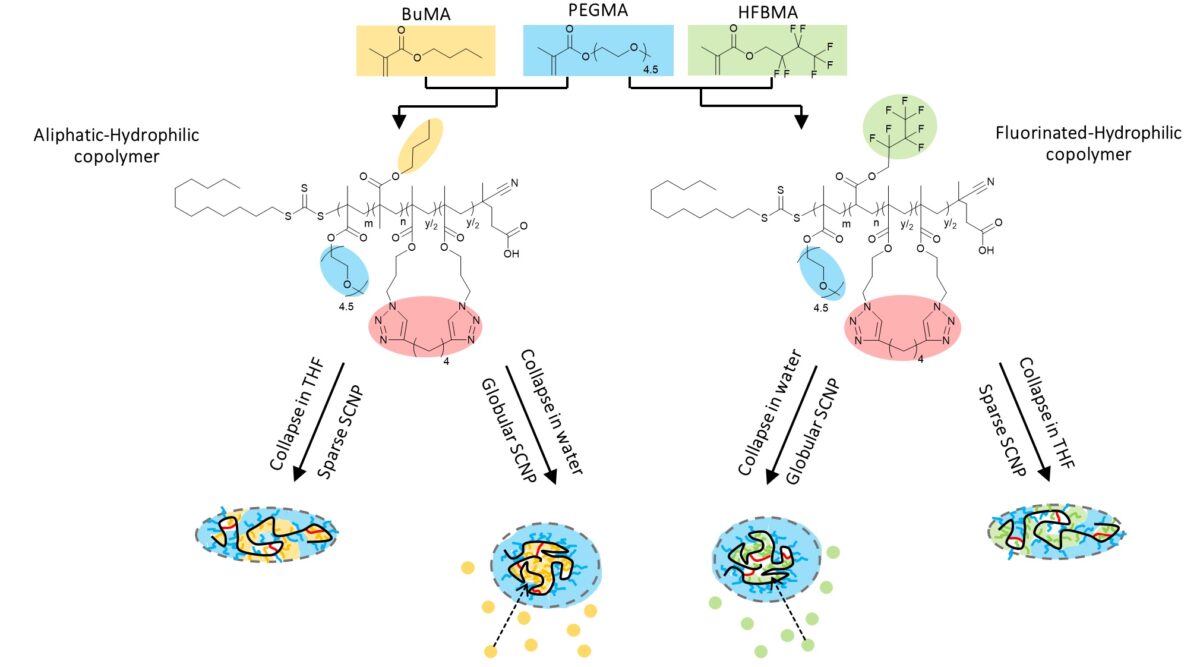
Tuning the nanoparticles internal structure: fluorinated single-chain nanoparticles (SCNPs) generated by chain collapse of random copolymers

Alqaisi, M. et. al., Polymer Chemistry, 2024, 15, 2949 – 2958, https://doi.org/10.1039/D4PY00355A

The generation of nanosized compartments in single chain nanoparticles (SCNPs) is a promising approach to generate individualized confinement-zones on a small scale for drug-encapsulation or catalysis. We here report the synthesis and characterization of compartmented, fluorinated SCNPs generated by single-chain collapse of amphiphilic copolymers. Polyethylene glycol (PEG) functionalized monomers were utilized as hydrophilic moieties, while hydrophobic residues were introduced using different mole fractions of either aliphatic or fluorinated monomers. Single chain collapse and subsequently crosslinking via copper-catalyzed azide–alkyne click reactions in selective and non-selective solvents yields internally structured SCNPs with hydrodynamic radii of 2.5–5.8 nm. Reproduced with permission from the Royal Society of Chemistry

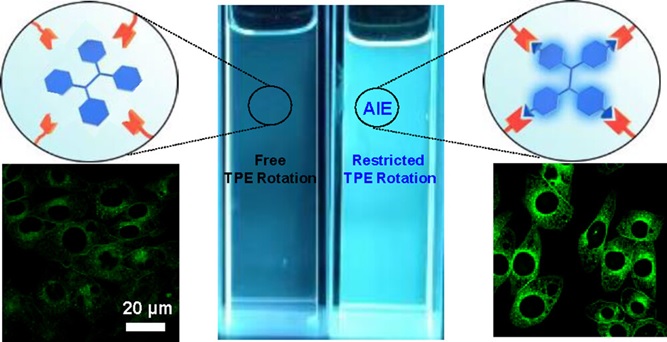
Hydrogen-Bonded Polymer Nanomedicine with AIE Characteristic for Intelligent Cancer Therapy

 Li, Z. et. al., ACS Macro Lett., 2023, 12, 10, 1384–1388, https://doi.org/10.1021/acsmacrolett.3c00493

Hydrogen-bonding (H-bonding) assembly incorporated with an aggregation-induced emission (AIE) capability can serve as a powerful tool for developing supramolecular nanomedicine with clear tumor imaging and smart therapeutic performance. We here report a H-bonded polymeric nanoformulation with an AIE characteristic toward smart antitumor therapy. To do so, we first design a structurally novel tetraphenylethylene (TPE)-based H-bonding theranostic prodrug, TPE-(FUA)4, characterized by four chemotherapeutic fluorouracil-1-acetic acid (FUA) moieties arched to the TPE core. A six-arm star-shaped amphiphilic polymer vehicle, P(DAP-co-OEGEA)6, is prepared, bearing hydrophilic and biocompatible POEGEA (poly(oligo (ethylene glycol) ethyl acrylate) segments, along with a hydrophobic and H-bonding PDAP (poly(diaminopyridine acrylamide)) segment. Thanks to the establishment of the DAP/FUA H-bonding association, incorporating the TPE-(FUA)4 prodrug to the P(DAP-co-OEGEA)6 vehicle can yield H-bond cross-linked nanoparticles with interpenetrating networks. For the first time, AIE luminogens are interwoven into a six-arm star-shaped polymer via an intrinsic H-bonding array of the chemotherapeutic agent FUA, thus imposing an effective restriction of TPE molecular rotations. Concomitantly, encapsulated photothermal agent (IR780) via a hydrophobic interaction facilitates the formation of nanoassemblies, TPE-(FUA)4/IR780@P(DAP-co-OEGEA)6, featuring synergistic cancer chemo/photothermal therapy (CT/PTT). Copyright © 2023, American Chemical Society

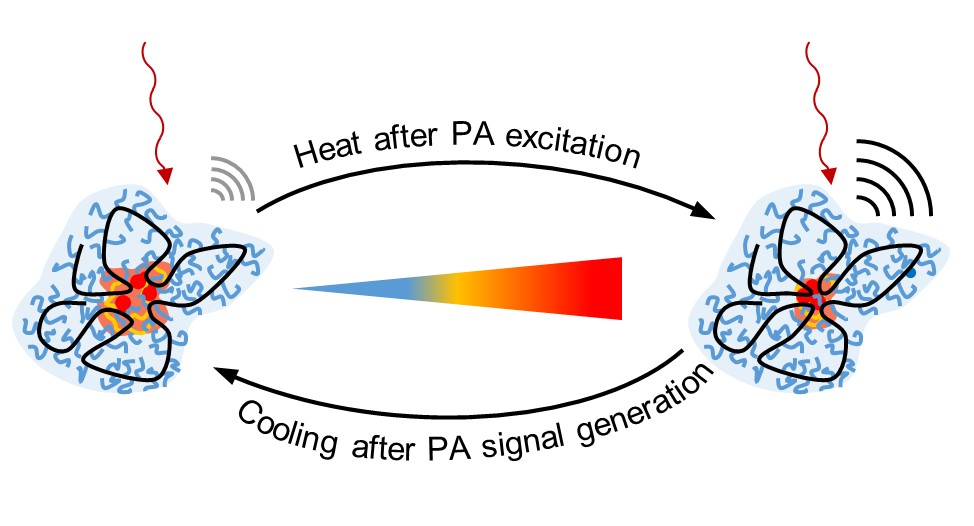
Thermoresponsive Swelling of Photoacoustic Single-Chain Nanoparticles

Thümmler, J. F. et al., Chemical Communications, 2023, DOI https://doi.org/10.1039/D3CC03851C

NIR-fluorescent LCST-type single-chain nanoparticles (SCNPs) change their photophysical behaviour upon heating, caused by depletion of water from the swollen SCNP interiors. This thermoresponsive effect leads to a fluctuating photoacoustic (PA) signal which can be used as a contrast mechanism for PA imaging. Rublished with a permission of the Royal Society of Chemistry 2023.

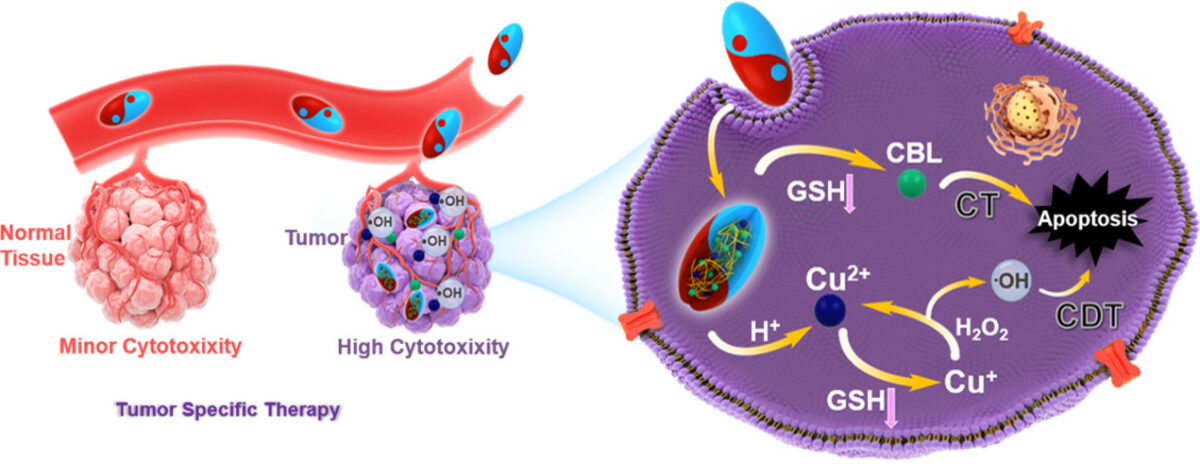
Core-Coordinated Elliptic Polymer Nanoparticles Loading Copper(II) and Chlorambucil for Cooperative Chemodynamic/Chemotherapy

Qiu, X. et al., Biomacromolecules, 2022, 4519–4531,

https://pubs.acs.org/doi/10.1021/acs.biomac.2c00656

Chemodynamic therapy (CDT) reflects an innovative cancer treatment modality. To enhance its relatively low therapeutic efficiency, rational combination with extra therapeutic modes is highly appreciated. Here, core-coordinated amphiphilic, elliptic polymer nanoparticles (Cu/CBL–POEGEA NPs) are constructed via the self-assembly of a glutathione (GSH)-responsive polymer–drug conjugate. Side-chain acylthiourea (ATU) motifs are affixed, which behave as ligands capable of coordinating Cu(II). Benefitting from the GSH-induced reduction reaction, Cu(II) is converted into Cu(I) and subsequently react with endogenous H2O2 to create OH, realizing GSH-depletion-promoted CDT. Additionally, the disulfide bond endows GSH-responsive CBL release and provokes further GSH decline, finally realizing combined CDT/CT toward enhancing antitumor outcomes, and in vitro as well as in vivo studies indeed reveal remarkable efficacy. Copyright © 2022, American Chemical Society.