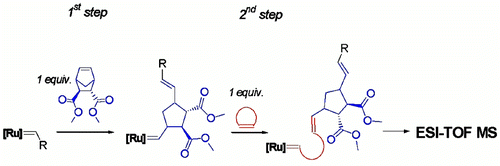
Monitoring ROMP Crossover Chemistry via ESI-TOF MS.

Kurzhals, S., et al. Macromolecules 2013, 46 (3), 597-607, DOI: http://dx.doi.org/10.1021/ma302555q.

We report on the ESI-TOF MS investigation of oligomerization and co-oligomerization reactions via ring-opening metathesis polymerization of noncharged monomers. Reproduced with permission. Copyright 2013©, American Chemical Society.

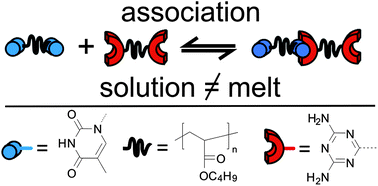
Comparing solution and melt-state association of hydrogen bonds in supramolecular polymers

Herbst, F., et al. Polymer Chemistry 2013, 4, 3602-3609, DOI: http://xlink.rsc.org/?doi=C3PY00362K.

Mono- and bifunctional poly(n-butyl acrylate)s (PnBAs) bearing different hydrogen bonding motifs (thymine (THY) or 2,6-diaminotriazine (DAT)) were prepared by a combination of atom transfer radical polymerization (ATRP) and azide/alkyne “click”-reaction to investigate the association of hydrogen bonding motifs in solution (toluene-d8) and in the melt state. Reproduced by permission of The Royal Society of Chemistry.

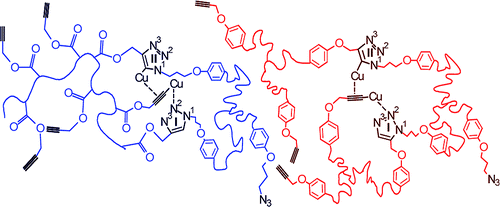
Autocatalysis in the Room Temperature Copper(I)-Catalyzed Alkyne–Azide “Click” Cycloaddition of Multivalent Poly(acrylate)s and Poly(isobutylene)s.

Döhler, D., et al. Macromolecules 2012, 45 (8), 3335-3345, DOI: http://dx.doi.org/10.1021/ma300405v.

We investigate autocatalytic effects in cross-linking processes based on the copper(I)-catalyzed alkyne-azide “click” cycloaddition reaction (CuAAC), taking advantage of the 1,3-triazole rings formed during the CuAAC-based cross-linking, which act as ligands for subsequent “click”-reactions in turn accelerating the reaction rate of subsequent CuAAC-reactions. Multivalent polymeric alkynes and azides (random poly(propargyl acrylate-co-n-butyl acrylate)s, Mn = 7000-23400 g/mol) were prepared via nitroxide mediated polymerization (NMP). The now designable significant autocatalytic effects together with the optimized reaction rate via the lowest molecular weight compounds enabled the design of a new, highly efficient and fast cross-linking system acting at room temperature. Reproduced with permission. Copyright 2012©, American Chemical Society.